
Italy has companies that design and manufacture complete passenger elevators, home lifts, freight lifts and specialized vehicle-lifting systems. These are different product categories, and a company that makes elevator components is not necessarily a manufacturer of complete lifts. For buyers, that distinction matters more than a generic “top ten” ranking.
This guide introduces ten companies with documented operations in Italy and identifiable lift products or systems. It explains what each company actually supplies, where its product focus may be useful, and what a developer, architect or procurement team should verify before requesting quotations. The entries are a practical shortlist, not a ranking by revenue, market share, customer satisfaction or independently tested performance.
Each entry meets three screening conditions: an identifiable company with a published Italian business location; official information describing a complete lift, home-lift, goods-lift or car-lift product range (or complete lift packages); and enough product information to help buyers compare suitable project applications. These checks rely on publicly available company materials, not factory inspections, cross-brand tests or independently verified service ratings.
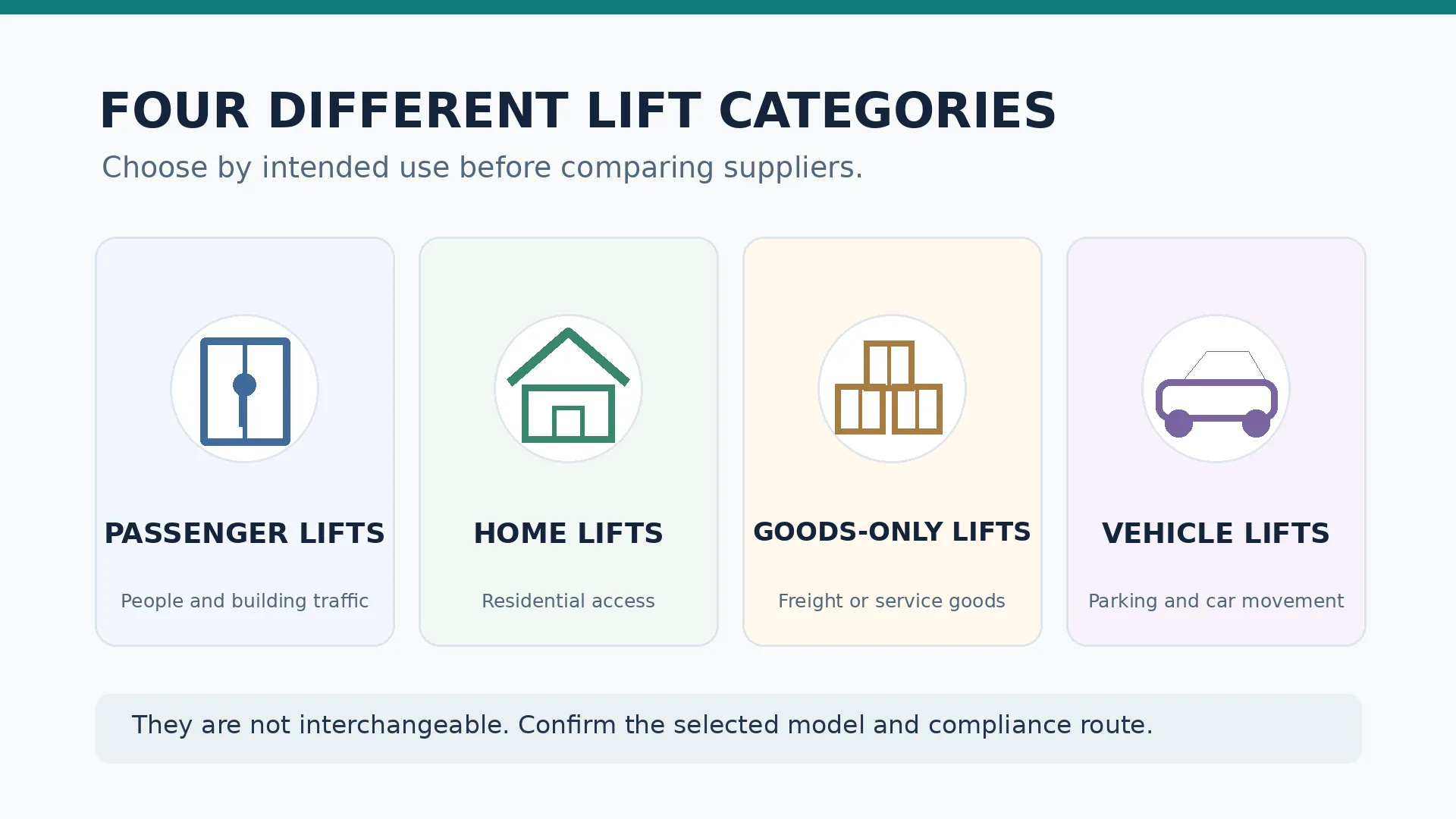
The list deliberately includes different specialisms. A compact homelift for a private residence, a goods-only dumbwaiter and a passenger elevator for a busy commercial building must not be treated as interchangeable. Product origin, the contracting entity, regulatory documentation and local installation or maintenance coverage must be confirmed for the model actually offered.
This is a focused shortlist of Italy-based lift manufacturers and specialist suppliers, not a directory of every elevator brand active in Italy. International groups such as Otis, KONE, TK Elevator and Schindler also offer lifts or services in the Italian market, but are outside these ten entries. An Italian sales or service presence alone does not prove that a specific model is manufactured in Italy.
Company | Italian location / supply role | Documented products and project fit |
MoviLift | Castellammare di Stabia — complete-lift and controls manufacturer | Passenger lifts; integrated controllers and modernization interfaces |
Benelifts | Milan — Italy-based lift supplier; origin varies by model | Home lifts and cabin products for residential projects |
NOVA Elevators | Crevalcore (Bologna) — home-lift and platform-lift manufacturer | Residential accessibility and compact installations |
Maspero Elevatori | Appiano Gentile (Como) — custom-lift manufacturer | Passenger, panoramic and inclined lifts; bespoke sites |
GMV | Novara — lift-technology and complete-package supplier | Hydraulic/electric components and complete lift packages |
Daldoss Elevetronic | Pergine Valsugana (Trento) — lift manufacturer | Compact passenger, freight and goods-only lifts |
CMAlifts | Corato (Bari) — passenger/home-lift manufacturer | New-build and constrained-shaft applications |
CEAM | Bologna — elevator business within the Otis Group | Passenger lifts and Italian installation/service partners |
IGV Group / DomusLift | Vignate (Milan area) — home-lift specialist | DomusLift and compact accessibility solutions |
IdealPark | Verona area — specialized car-lift manufacturer | Parking access, vehicle lifts and tight site layouts |
The table describes company-published product scope; it does not compare measured reliability, price, lead time or after-sales performance.
MoviLift describes itself as an Italian manufacturer of complete lifts, control panels and elevator electronics. Its offering includes passenger lifts and solutions for home, hospital and other specialist applications. A distinguishing feature is the company's integration of lift packages with its own controls and electronic systems, rather than a claim that it has the lowest price or the best reliability.
For projects combining complete lift equipment with in-house controls, MoviLift offers an identifiable point of comparison for equipment–controller integration. This is especially relevant to modernization: the retained installation, new control interfaces and division of technical responsibility need to work as one specified system. The distinction is integration scope, not a presumed advantage in price or performance.
Benelifts publishes a Milan address and offers home-lift and cabin products. Its website also identifies Turkey as the manufacturing location for some ELUX home-lift models. An Italian company address is not proof that every listed lift is manufactured in Italy. Benelifts is therefore included here as an Italy-based supplier rather than presented as a universally Italian-made elevator manufacturer.
Its home-lift listings can be considered for villas and residential projects where enclosure design and the available installation envelope matter. The defining sourcing question is traceability: a proposal from a Milan company may include a model made elsewhere. Product-series and factory identification therefore matter more here than the address on the quotation.
NOVA Elevators focuses on home lifts and platform lifts designed and manufactured in Italy. Its Suite family and other specialized homelift models address residential accessibility, architectural appearance and installation in a variety of home environments. This is a more precise description of NOVA's published portfolio than presenting it as a general high-rise or intensive-traffic elevator manufacturer.
NOVA is most relevant where a home renovation requires a compact design and a clearly defined accessibility function. The critical comparison is between the actual product categories: a home lifting platform and a conventional passenger lift can have different technical and conformity requirements. Model-specific pit, headroom and entrance dimensions should determine feasibility.
Maspero Elevatori designs and manufactures custom vertical transport systems in Italy, including conventional passenger elevators, panoramic lifts, inclined elevators and special-purpose configurations. Its published manufacturing base is in Appiano Gentile, in the province of Como. The company's focus on project-specific engineering distinguishes it from suppliers whose main offering is a standard domestic lift package.
Maspero is best evaluated through the quality and scope of project-specific engineering rather than a generic catalogue comparison. Inclined travel, panoramic exposure or unusual structural geometry can make feasibility drawings, load paths, interfaces and approval responsibilities central to the procurement decision. A bespoke concept still requires site-specific engineering validation.
GMV is an Italian lift-technology company with a long-established business in hydraulic systems. Its official materials describe hydraulic and electric lift components as well as complete lift packages; these are distinct supply categories. GMV should not be reduced to a parts-only supplier, but a quotation for a hydraulic power unit should not be mistaken for an offer for a complete installed elevator.
GMV illustrates why the boundary of supply matters: a hydraulic power unit, electrical lift components, a complete package and a commissioned elevator are not equivalent offers. The useful comparison starts with the specified drive system and component scope, then checks how installation and later parts support are assigned. Its broad technology range does not make every quotation turnkey.
Daldoss Elevetronic publishes ranges for compact passenger lifts, freight lifts, lifting platforms and dumbwaiters. Its Microlift is a goods-only small freight lift for applications such as hospitality, healthcare and retail service areas; this is not the same product category as a passenger elevator. Daldoss also offers the EasyGo compact lift and equipment for heavier goods movement.
Daldoss provides a clear category distinction for hospitality, retail and service areas: a goods-only Microlift is not an occupied passenger lift, while other product ranges address different travel and load needs. The determining design inputs are whether people may ride, the load footprint, landing arrangement and usage pattern. These should be settled before a model is compared on size or price.
CMAlifts is an Italian manufacturer based in Corato, in the province of Bari. Its official company information identifies passenger lifts, home lifts and elevators for civil and industrial applications. Its product materials also describe special configurations for reduced shaft dimensions, panoramic designs and other non-standard building requirements.
In renovation work, measured shaft and entrance geometry often determine which standard or reduced-space configuration is feasible. CMAlifts is therefore a candidate for a drawing-based comparison of the available pit, overhead, door clearances and rated load. Published compact options are model-specific, not a promise that an arbitrary existing shaft can be accommodated.
CEAM is an Italian elevator company headquartered in Bologna. Its published range includes passenger elevators, home-lift or lifting-platform solutions, hydraulic systems and special installations. CEAM's own company history states that it became part of the Otis Group; its Italian partner network for installation, service and maintenance should be understood in that group context, not presented as an unrelated independent manufacturer.
CEAM is a useful comparison for projects in which equipment supply and local service may be organized through related but legally distinct partner companies. Its Otis affiliation and partner-network model are relevant to contract accountability: the bid should identify the seller, installer and maintenance party for the particular address. Group membership alone is not evidence of a specific service response time.
IGV Group is an Italian manufacturer associated with the DomusLift range. Its official materials emphasize home lifts, lifting platforms and designs with reduced pit or headroom requirements, making its product focus distinct from conventional commercial passenger-elevator systems.
IGV's reduced-pit and reduced-headroom designs may be relevant to heritage buildings and homes where extensive structural work is undesirable. The project decision remains model- and category-specific: platform size, travel, landings and user access must fit the actual building. A compact home-lift product should not be treated as a substitute for a conventional passenger elevator without checking its intended use and regulatory classification.
IdealPark is an Italian manufacturer of car lifts and mechanical parking solutions, with production described at its Verona-area location. Its product range includes vehicle lifts for parking access and configurations designed to integrate with buildings where driveways, ramps or visible parking space are constrained.
IdealPark is included as a vehicle-lifting specialist, not a general passenger-elevator manufacturer. Where a conventional ramp is impractical, a car lift may offer a different parking-access layout; suitability depends on the vehicle envelope, platform approach, safety provisions and structural context. Permitted occupant conditions and applicable machinery or lift requirements must be established for the specific model.
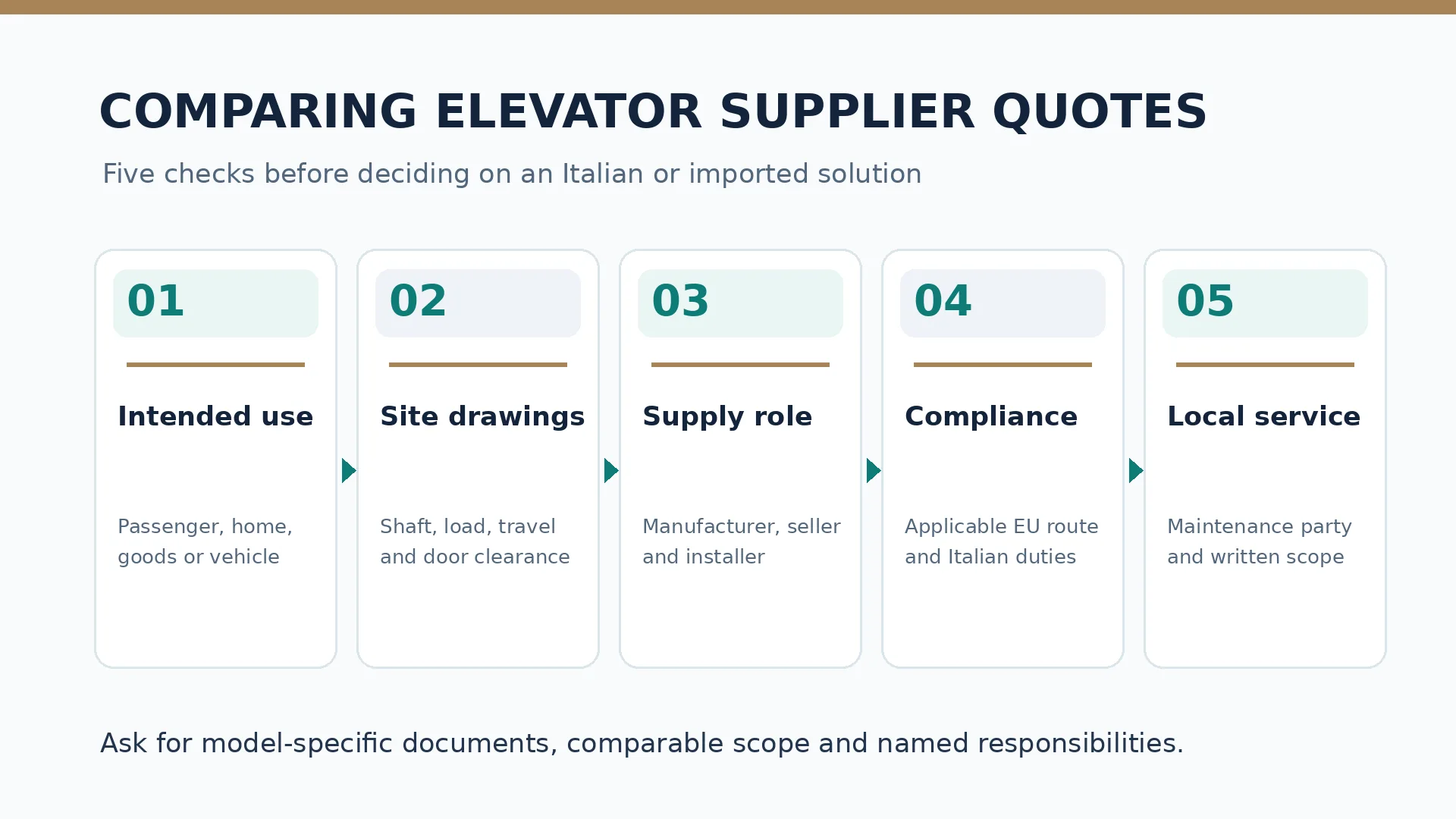
Supplier quotation comparison checklist. Confirm all details for the actual model and project.
Start with the intended use: passenger transport, residential accessibility, stretcher transport, freight or vehicle movement. Then supply the number of stops, travel height, rated load, available shaft dimensions, pit and headroom, door arrangement and expected traffic. A home lift, a car lift and a passenger elevator may solve different problems even when they are marketed under the same broad word, “lift.”
Ask whether the offer is for a complete elevator, a lift package without installation, components for an existing system, or an installed and commissioned solution. Identify the factory, the seller, the installer and the ongoing service contractor. A company with an Italian office may manufacture individual products elsewhere; this is a sourcing detail to verify, not an assumption to make from the brand name.
In the EU, conventional lifts within the scope of the Lifts Directive 2014/33/EU follow a different regulatory framework from certain lower-speed lifting platforms or machinery. Applicable harmonised standards, including relevant parts of the EN 81 series, support technical compliance but are not a substitute for the correct conformity assessment, declaration and CE marking. The wider machinery framework is also changing, with Regulation (EU) 2023/1230 generally applicable from 20 January 2027. Have the supplier and local project professional confirm which rules apply when the equipment is placed on the market or put into service.
For an Italian installation, D.P.R. 162/1999, as amended, also sets national requirements for bringing relevant lifts into service, maintenance and periodic inspections. The owner and Italian installer should establish the obligations applicable to the exact device, including whether a platform or other slower-speed lifting device falls within particular provisions. EU product conformity and Italian in-service duties are related, but they are not the same check.
Request itemized offers covering the exact lift model, engineering, equipment, shipping, civil work assumptions, installation, commissioning, testing, handover, warranty terms and maintenance proposal. A factory equipment price is not automatically an installed project cost. Compare exclusions, spare-parts availability and responsibilities for corrective work before drawing a price conclusion.
Ask who will carry out the initial installation, routine maintenance and emergency response. Obtain the proposed local contractor's identity, relevant credentials, spare-part arrangements and written service terms. Do not infer a specific response time or coverage level from a manufacturer's Italian business address alone.
An Italian manufacturer can be convenient when its relevant model, contractor network and service arrangements match a project's requirements. An overseas manufacturer may also be considered, but the buyer and local project team must verify the product's regulatory route, documentation, transportation, installer responsibilities and after-sales support. Neither origin automatically establishes a lower lifetime cost or better performance.
For projects considering a manufacturer outside Italy, Delfar's elevator-supply information for Italy provides a separate starting point. Delfar is a China-based supplier, not an Italian manufacturer; any specific imported lift should be assessed against the same documented technical, conformity and service requirements as other quotations.
No. The list covers Italy-based companies with different supply roles. Some manufacture complete passenger elevators, some focus on home lifts or lifting platforms, and IdealPark specializes in car lifts. Benelifts publishes an Italian address but identifies production outside Italy for some products. Buyers should confirm the manufacturing entity and model-specific product scope.
The requirements depend on the equipment category and its intended use. Conventional lifts may fall under Directive 2014/33/EU, while certain lifting platforms and machinery follow a different framework. Ask for the appropriate EU declaration, CE-marking information where applicable, technical documents and the basis for conformity assessment. A general statement that equipment is “EN 81 certified” is not enough to establish project compliance.
There is no reliable universal price for every type of lift. The overall budget depends on load and travel, drive technology, shaft and structural works, doors and finishes, delivery, installation, testing and ongoing service. Request comparable, itemized project quotations instead of treating a broad online price range as a guaranteed installed cost.
Lead times depend on the selected model, customization, production scheduling, building readiness, transportation, site work and commissioning requirements. Request a supplier schedule that separates manufacturing, delivery, installation, testing and handover. A generic number of days should not replace a project-specific program.
Compare technically suitable proposals rather than choosing on origin alone. An Italian supplier and an overseas manufacturer may offer different contracting and service arrangements. Ask both to identify the responsible installer, the regulatory documentation for the proposed equipment, spare-parts access and the full installed scope before making a procurement decision.
The most useful shortlist is the one that matches the building and clarifies responsibility. Confirm the equipment category, model, manufacturing source, rated load, site dimensions, technical documents, installation scope and local maintenance support. This comparison is based on company-published information; it is not a test-based ranking or a substitute for detailed engineering and procurement review.
Get Elevator Solution for Italy— Share your project type, required capacity, travel height and available shaft dimensions to discuss a suitable equipment proposal.
 English


